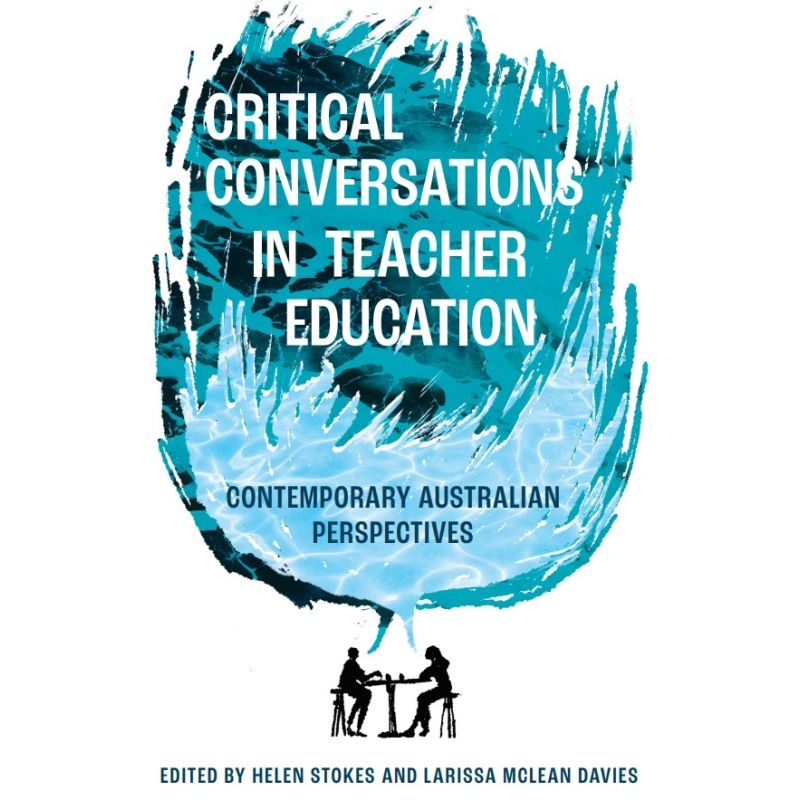
I am excited to share that our chapter was recently published in the book, ‘Critical Conversations in Teacher Education, Contemporary Australian Perspectives’, edited by Professor Helen Stokes and Professor Larissa McLean Davies.
The chapter was led by my friend and colleague Monique Langley-Freeman and co-authored with inspiring leaders from Berry Street, Dr Tom Brunzell and the University of Melbourne, Faculty of Education, Dr Jessica Gannaway and Professor Melitta Hogarth.
Perhaps the most powerful invitation in the chapter is for educators to enact the micro-moment through a lens of systems change, to quote an excerpt from the chapter:
“Building anti-racist, anti-bias, equitable systems cannot be done on the macro level only. Equitable systems are enacted in daily life, from moment to moment. Structural inequity, for example, frequently manifests in deeply engrained bias and modes of being that can take a long time to break down. As such, we need tools to support individual educators and students to manage the micro-moment, while also reflecting on the ways in which these micro-moments feed into and create systems.”
Within the current landscape of social complexity in Australian schools, this frame can helpfully guide educators toward teaching practices that are responsive to student needs in the moment and contribute to the systemic movement for social justice.
Citation:
Langley-Freeman, M., Greig, J., Brunzell, T., Gannaway, J., & Hogarth, M. (2025). Towards Culturally Responsive, Trauma-Informed Education: Navigating Social Complexity in Australian Schools. In Critical Conversations in Teacher Education (pp. 81-97). Emerald Publishing Limited.
Abstract:
Culturally responsive education (CRE) seeks to dismantle systemic barriers by situating school-based learning within students’ lived experiences and broader cultural frames. These approaches explicitly acknowledge the strengths and values inherent within students’ own cultures, alongside the impacts that colonisation, systemic racism, and educational inequities can have on student wellbeing, learning, and academic achievement. This chapter examines the confluence of CRE and trauma-informed education (TIE), and the ways in which they can fortify each other. A relatively new paradigm with promising results, TIE provides indications for healing-focussed strategies appropriate within the context of schools (i.e., increasing self-regulatory capacities and repairing disrupted relational attachment) in addition to strengths-based, wellbeing-focussed strategies. A trauma-informed approach that primarily responds to individual experiences and traits without looking towards the broader context of culture, systemic inequity, or intergenerational trauma is not enough. By considering these approaches together, educators can proactively address the emerging needs of both the individual student and the collective student body within superdiverse schools. This chapter will set the grounds for a conceptual meeting place of CRE and TIE, as well as explore critical conversations that educators can engage in to strengthen emergent practice at this intersection. These conversations support two goals within both TIE and CRE. The first, to assist classroom teachers and school-based practitioners to meet the complex behavioural, cognitive, and relational needs of all students in schools. The second, to centre the foundational rights, needs, and strengths of diverse students and families so that our educational systems can move towards becoming actives site of cultural inclusion and structural healing.
Access:
Here’s a link to access the full chapter via the Emerald Publishing website.

 jack v. greig